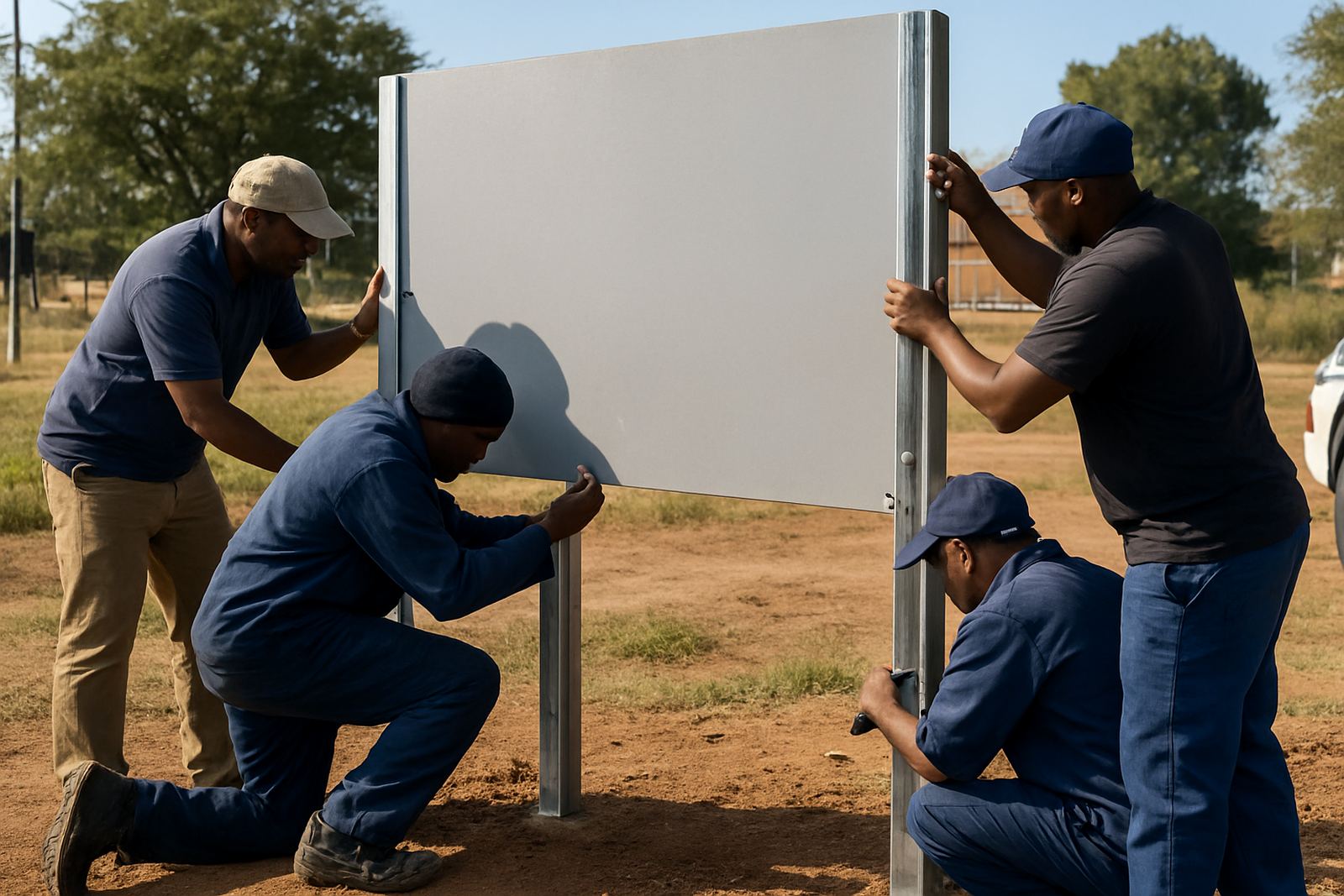
What Board Mounting Covers
Board mounting is the part that gets a sign from the workshop to a finished position on site, standing straight and fixed securely. We mount property boards, developer boards, site notices, directional boards and temporary construction boards on practical timber or steel supports. Where the site calls for it, we also set the board at a height and angle that improves visibility from the road, gate or walkway.
Our team works on private land, commercial premises, industrial yards and roadside locations across Boksburg, Benoni, Germiston, Kempton Park, Alberton, Springs, Edenvale and Midrand. In some areas a board needs a simple post set in soil, while in others the surface is concrete, paving or compacted gravel. We choose the mounting method to suit the ground, the board size and the exposure to wind, dust and load shedding related security changes on site.
- Single or double faced boards
- Temporary and long term installations
- Timber or steel support structures
- Directional, property and site boards
- Replacement mounting for damaged frames or posts
How We Prepare The Site And Support Structure
Before installation, we check the board dimensions, weight and the fixing points on the panel. Standard boards are often mounted on treated timber uprights for shorter term use, while heavier or more exposed signs may need steel posts and cross members. For larger boards we allow for wind load, especially in open areas and on corners where gusts can catch the panel.
We can work from client supplied boards or from boards made by our production team. If the site has poor access or a tight boundary line, we plan the work so the board lands where it can be read without blocking driveways, gates or service access. Where necessary, we also advise on the right clearance above ground, because a board mounted too low is easy to damage and too high can become hard to see from a vehicle.
- Measuring board size and fixing positions
- Checking access, ground level and visibility
- Selecting timber or steel supports
- Planning post depth and spacing
- Confirming any site rules before work starts
Our Mounting Process From Setup To Final Tightening
We start with a site survey or a clear brief with the board size, location and ground type. After that we confirm the post layout, mark the set out points and prepare the supports. On site, holes are dug or drilled as needed, the uprights are set plumb and the board is fixed with suitable brackets, bolts or screws. The final step is a careful check that the panel sits level and is secure.
If the board is being mounted on an existing structure, we inspect it first for rust, rot, movement or loose fixings. It is no use fitting a fresh board to a weak frame, because that just creates problems later on. Where practical, we can remove an old board, repair the support and fit the replacement in the same visit, which saves time and keeps the site tidy.
- Site check and measurement
- Set out and post placement
- Fixing of board to support structure
- Level check and tightening of all hardware
- Cleanup of offcuts and installation debris
Typical Specs And Fixing Options
Board mounting is not one size fits all. A 1.2 m by 0.8 m board for a property boundary needs a different support from a 3 m by 2 m contractor board beside a busy road. We look at the panel material, usually foam board, ACM, corrugated board or printed PVC, and then choose a fixing method that supports the weight without distorting the face.
For timber supports we use treated poles and cross braces where required. For steel support, we work with painted or galvanised sections depending on the exposure and budget. In coastal humidity or on sites with frequent water spray, steel needs better protection against corrosion, and we make that clear up front. Fasteners are selected to suit the job, because the wrong screw or bolt can work loose after a few weeks and that is a waste of money.
- Common board sizes from 600 x 600 mm to 3 m x 2 m and larger
- Support options in treated timber or steel
- Ground fixing for soil, gravel, paving or concrete edge conditions
- Hardware matched to board material and wind exposure
- Optional anti tamper fixings for public facing sites
Turnaround And Pricing Approach
Turnaround depends on the board size, the number of mounting points and whether the site is ready for installation. A simple small board on an easy access site can often be completed quickly, while larger roadside boards or multi panel directional runs need more preparation. If a site survey is needed first, we schedule that before giving a firm timing.
Our pricing is based on the actual work involved rather than a flat guess. That means we consider board dimensions, support type, site conditions, number of labour hours, fixings and delivery if needed. This keeps quotes practical and transparent. Clients often ask for the cheapest option, but a board that leans after two months is not cheap at all. We aim for a sensible balance between cost and durability, with no unnecessary extras.
- Pricing based on board size, support type and site conditions
- Separate allowance for delivery or multiple site installs
- Quoted after survey or clear measurements
- Suitable for once off jobs and repeat roll outs
Maintenance Checks That Keep Boards Safe And Visible
Mounted boards should be checked at regular intervals, especially after storms, heavy wind or a hard summer downpour. We recommend a simple maintenance visit every 6 to 12 months for permanent boards, and sooner for temporary boards on active construction sites. The check should cover post movement, rust, rot, loose fixings, fading and ground settlement.
If a board starts to tilt or wobble, the issue is often the support rather than the print. Catching that early is the difference between a small repair and a full replacement. For sites in busy industrial areas or along roads with vibration from traffic, we can recommend a tighter inspection cycle, because vibration slowly loosens fittings even when everything looked fine at first.
- Check for loose bolts and brackets
- Inspect timber for splitting or softening
- Look for steel corrosion and paint failure
- Confirm the board is still level and visible
- Adjust maintenance intervals for exposed sites
Why Clients In Gauteng Use Our Team For Mounting
Executive Screen Printers has been operating in Boksburg since 1988, and our team knows how to handle the practical side of sign work, not just the printing. Our board mounting service is led on site by experienced staff who understand access, site safety and the kind of weather that can turn a quick job into a messy one if it is not planned properly. Michael Johannes van der Merwe oversees the business, with support from Lerato Mokoena, Johan Pretorius, Nokuthula Dlamini, Sibusiso Khumalo, Ayesha Patel and Pieter Erasmus.
Clients use us for one off installations, replacement mounting and larger roll outs across Ekurhuleni and greater Gauteng. If you already have a board and only need it mounted, or if you want the board made and installed in one go, we can assist through the enquiry form on our contact page. We keep the process straightforward, from measurements to final tightening, so the board is up and standing properly the first time round.
Key facts
| Support materials | Treated timber or steel |
|---|---|
| Typical board sizes | 600 x 600 mm up to 3 m x 2 m and larger |
| Mounting surfaces | Soil, gravel, paving and concrete edge conditions |
| Fixing methods | Bolts, screws, brackets and anti tamper options |
| Maintenance interval | Every 6 to 12 months for permanent boards |
| Service area | Boksburg, East Rand, Ekurhuleni and greater Gauteng |