What a shopfront sign does from the street
A shopfront sign is the main identification panel fitted above or beside your entrance, usually where customers first spot the business from a passing car or pavement. It can be a flat panel with printed or cut lettering, or a built-up sign with raised letters that give more depth and shadow. Both styles help people find you quickly, which matters on busy roads in Boksburg, Benoni, Germiston and Kempton Park where traffic moves fast and parking is often tight.
For many businesses, the sign is also part of the customer experience. A clean sign gives the right first impression for a salon, takeaway, medical room, office suite or retail frontage. It must be legible in direct sun, after load-shedding, and in wet weather when surfaces can dull or reflect light. We look at the viewing distance, mounting height and surrounding colours before recommending a size and finish.
Sizes, formats and material choices that suit your frontage
There is no single standard size for a shopfront sign because every building has its own fascia width, parapet height and mounting limits. Most signs are made to fit the available face of the building, with the lettering scaled for reading from the opposite side of the road or from the parking bays. A narrow frontage may need a long slim panel, while a corner site can take a wider sign with side visibility as well.
Common options include 3 mm to 6 mm aluminium composite panels, flat ACM panels with vinyl graphics, cut acrylic letters, applied vinyl on a painted wall, and built-up letters or logos fixed on stand-off studs. For larger centres or industrial sites, we also make directional panels and matching name plates so the front sign and internal signage look consistent. If the surface is uneven, we can measure it during a site survey and suggest a backing board or frame. It keeps the job tidy and saves trouble later.
- Small fascia signs: suited to 1.2 m to 2.4 m widths for street-facing shops
- Medium shopfront signs: often 2.4 m to 4.8 m wide for offices and retail units
- Large frontage signs: made to suit building spans above 5 m
- Raised lettering: usually 10 mm to 50 mm depth depending on the profile
Where shopfront signs work best
Shopfront signs suit almost any customer-facing business that needs to be found quickly and consistently. They are a practical choice for trading spaces in retail parks, roadside units, medical suites, estate agency offices, service centres and small industrial parks. If your building has security grilles, shaded awnings or a narrow pavement, the sign still needs to be placed where it can be read from the street and not hidden by fittings.
In coastal humidity or dusty inland conditions, the right material and fixings matter. In and around Ekurhuleni, temperature shifts and afternoon storms can loosen poor fixings, so we use proper anchoring and weather-resistant hardware. If the frontage is part of a landlord-controlled property, we also help check that the proposed sign size, projection and position fit building rules and local municipal requirements before fabrication starts.
- Retail shops and convenience stores
- Professional offices and reception fronts
- Motor trade, parts counters and service bays
- Food outlets, salons and wellness rooms
- Warehouses with customer collection points
Installation, power and site requirements
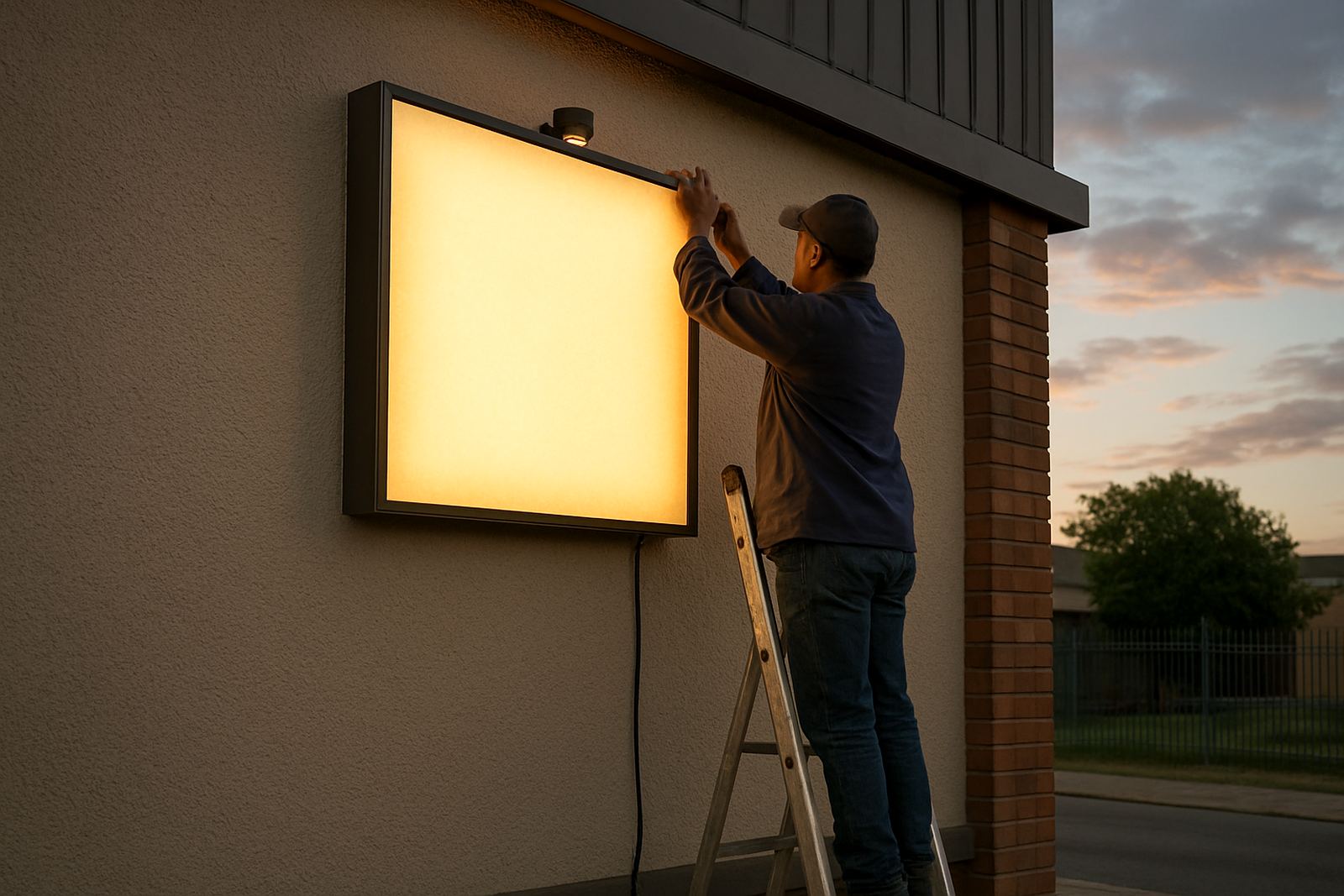
Most flat shopfront signs do not need power unless you want lighting, while built-up signs can be made with or without illumination. If lighting is included, we plan for safe electrical access, a nearby power source and a route for cables that is neat and protected. On some sites, the electrician may need to provide a dedicated point, isolator or timer. We can coordinate the practical side so the sign installer and the electrical work line up properly.
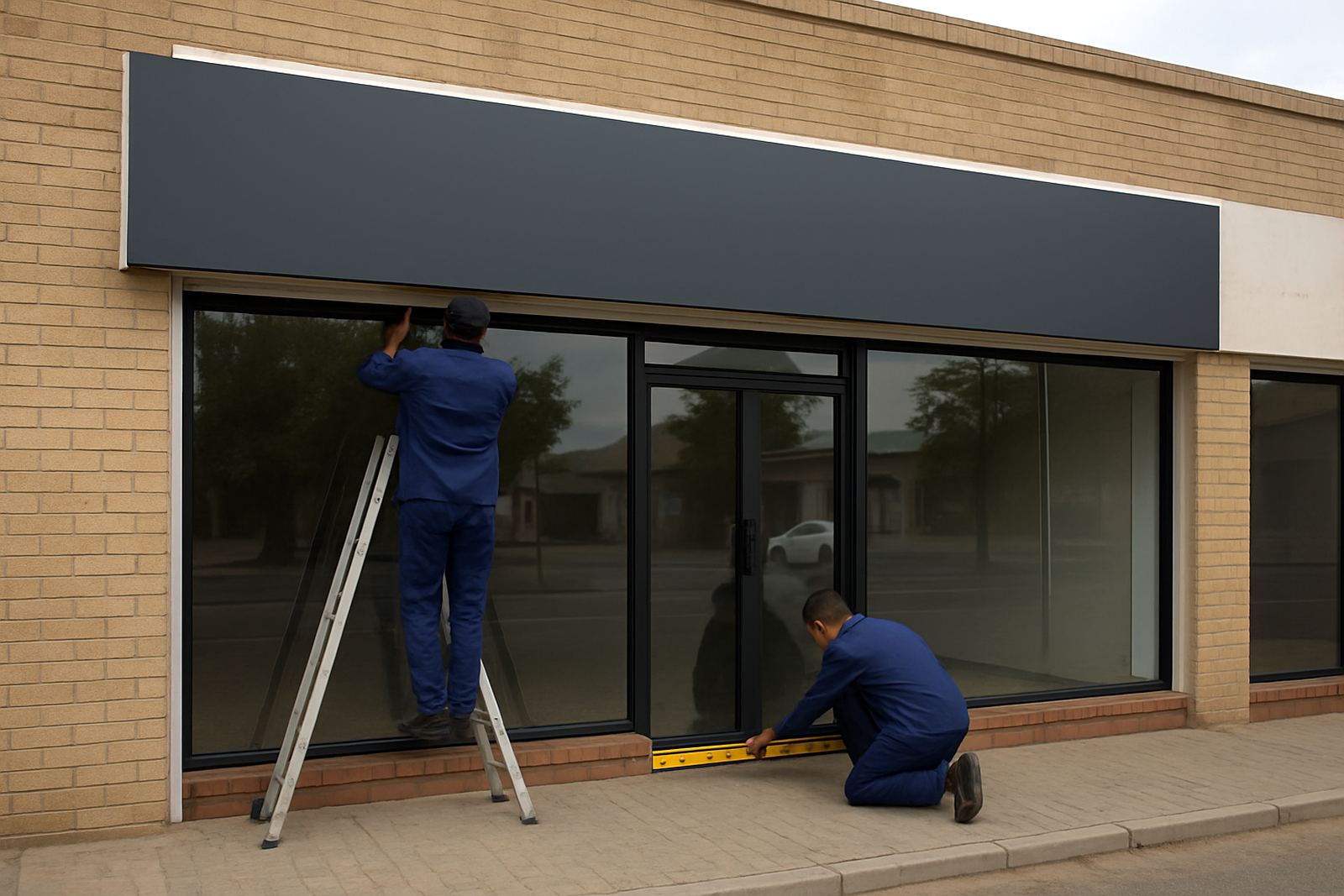
Installation usually starts with a site survey and confirmed measurements, then artwork approval, manufacture and fitment. Depending on the height and access, we may use ladders, scaffold or a small lifting platform. A solid fascia, wall or frame is important because the sign must sit level and stay secure in wind. If the old sign needs to come off first, we can also handle vinyl removal, board mounting and making good the surface where possible. It saves the client from dealing with several trades at once.
- Power is only needed for illuminated signs or accent lighting
- Access may be required behind the fascia for fixings or cable work
- Some installations need after-hours work to avoid disrupting trading
- We check for cracks, loose cladding and unsafe mounting points before fitment
Care, cleaning and servicing after fitment
A shopfront sign should not need constant attention, but a little care keeps it readable for longer. Most flat panels can be cleaned with mild soap and water, a soft cloth and a gentle rinse. Avoid abrasive pads, strong solvents or high-pressure spray too close to edges and joins. Built-up letters and illuminated signs need a bit more care because dust, spider webs and water spots can build up around the sides and faces.
We recommend periodic checks, especially after heavy wind, hail or a long spell of dust. On some busy roads, vehicle exhaust and road grime can dull the face quicker than expected, and that is usually when a maintenance visit helps. If the sign is part of a larger branding package, it may be worth refreshing the front panel, fixing loose vinyl or replacing a faded section before the whole frontage starts to look tired.
- Wipe down monthly in dry, dusty areas
- Check fixings after storms or strong wind
- Replace damaged vinyl before it lifts further
- Arrange maintenance if lighting flickers or goes dim
What to confirm before ordering your sign
Before production begins, it helps to confirm the frontage width, the mounting height, the viewing distance and whether the sign must match existing branding already used on vehicles, uniforms or other boards. We also ask what the sign must say exactly, because spelling, registration details, trading hours and contact lines all need to be right before manufacture. A quick approval stage avoids rework and unnecessary delay.
For local businesses in Boksburg and nearby areas, it also helps to know whether the property is owner-occupied or leased, whether the landlord has sign rules, and whether there are height restrictions or shared centre requirements. If the sign will be installed near a road reserve, secure gate or municipal boundary, that needs checking too. Our team can guide the process from first measurement to final fitment so the finished sign suits the site and does its job properly.
Executive Screen Printers makes shopfront signs for commercial and industrial sites across Ekurhuleni and greater Gauteng, with work handled by a practical team led from Boksburg. From first survey to installation, we keep the process straightforward and fit for the property.
Key facts
| Product type | Flat or built-up shopfront signs for exterior frontage use |
|---|---|
| Common materials | Aluminium composite, acrylic, cut vinyl, painted boards, metal framework |
| Typical sizes | From about 1.2 m wide to 6 m plus, made to site measurements |
| Illumination | Optional, with safe electrical planning for lit signs |
| Mounting | Wall fixed, fascia fixed or frame mounted depending on site |
| Service area | Boksburg, Benoni, Germiston, Kempton Park, Alberton, Springs, Edenvale, Midrand and wider Gauteng |