Why the post matters as much as the board
A sign can look well made and still fail early if the support is wrong. A light notice board on a shop wall may only need simple fixings, but a freestanding board for a site entrance, school or estate needs a post that can carry wind load, resist movement and suit the ground it sits in.
In the East Rand, we see this often where a client wants a bigger board for better visibility from traffic on busy roads. If the support is too thin, too short or poorly set in the ground, the board starts leaning after the first heavy rain or strong wind. Once that happens, the message becomes harder to read and the whole installation looks neglected.
At Executive Screen Printers in Boksburg, we match the support to the job, not just the artwork. That means considering the board size, whether the sign is temporary or permanent, and how much maintenance the client is willing to do over time.
When steel posts make more sense
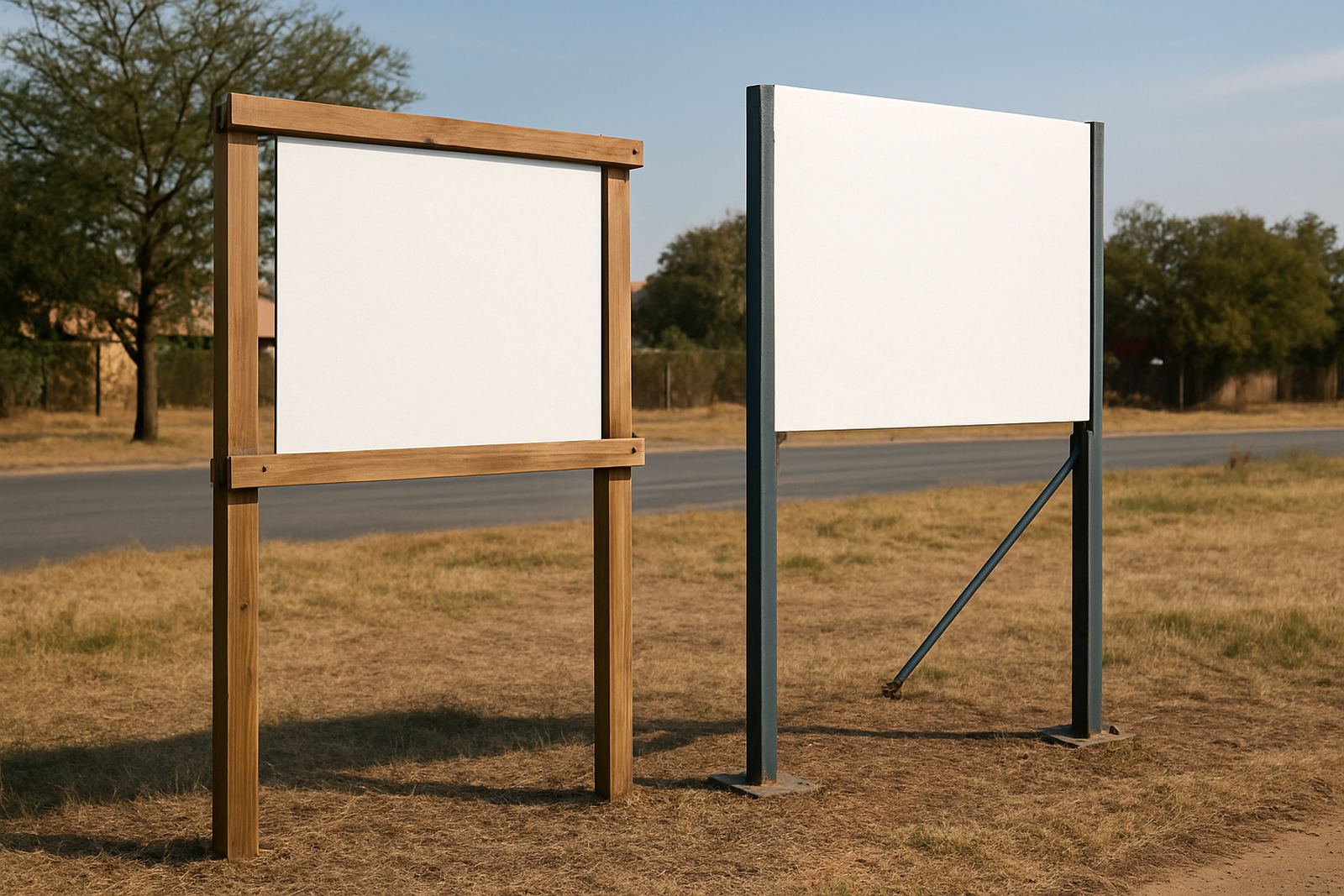
Steel is usually the better choice for larger boards, exposed sites and any installation that needs a longer service life. It gives better rigidity, handles heavier panels and can be fabricated to suit odd sizes more easily than timber. For commercial signs, estate boards, contractor boards and fleet-related yard signs, steel is often the safer option.
In Gauteng, many signs sit in open areas where wind, dust and sun do their work every day. Steel posts cope well with that if they are properly treated and installed. On coastal projects the issue is different, since moisture and corrosion become a bigger concern. In those cases, the coating and finish matter just as much as the post itself.
- Best for large or tall boards
- Good for long-term installations
- Suitable where wind exposure is high
- Can be coated, painted or galvanised for better durability
Steel also works well when you need a neat, professional finish at an entrance or roadside. It is easier to standardise across multiple branches or sites, which helps when a company wants the same look in Boksburg, Benoni, Germiston and Kempton Park.
When timber is the better fit
Timber is still useful where the sign is smaller, the budget is tighter or the project needs a more natural look. It can work well for short-term boards, garden-related signage and certain rural or low-traffic sites. For some estate directions and community notices, timber posts are perfectly acceptable if they are sized correctly and treated properly.
That said, timber needs more care. It can warp, split or rot if it is not treated for outdoor use. In hot weather and after repeated wet-dry cycles, untreated timber moves. On a site in Springs or Alberton, where a board may stand through heat, rain and dust, that movement can shorten the life of the installation.
If you choose timber, the treatment and depth of the footing matter. The post should be strong enough for the board width and tall enough to keep the sign clear of grass, parked vehicles and passing people. A post that is too thin is false economy because it will need replacement sooner.
Match the support to the board size and site conditions
The first question is simple: how big is the board? A small directional sign and a large roadside board do not need the same support. The second question is just as important: what is under the ground? Soft soil, compacted fill, clay or old rubble all change the way a post performs.
For example, a sign on a new development in Midrand may need deeper footing because the ground has been disturbed during construction. A sign at an established premises in Boksburg may face different conditions, such as compacted soil and vehicle movement close to the edge of the driveway. The support needs to suit that reality, not just the drawing.
- Board width and height
- Wind exposure and open space around the sign
- Soil type and drainage
- Expected lifespan of the sign
- Whether the sign needs to be movable later
We also look at how the sign will be viewed. If the board must be read by traffic at speed, the angle and height matter. A support that is too low, or a board that sags, can reduce visibility quickly. Good support work helps the sign do its job without constant attention.
Installation details that affect lifespan
The best post can still fail if the installation is rushed. Footing depth, concrete setting time and alignment all matter. A post must stand plumb from the start, because once the concrete cures, correction is far more difficult. If the sign is installed on a slope or in a drainage path, extra care is needed so water does not gather around the base.
For steel, we often recommend a finish that suits the site exposure. For timber, treatment and sealing should be checked before installation. If the board is being mounted in an area with frequent load-shedding related security issues, it is worth thinking through visibility and placement so the sign remains useful after dark as well.
Maintenance also matters. A sign near road dust, sprinkler overspray or industrial activity may need regular checks. Loose bolts, rust spots and cracked footing are easier to fix early than after the post has started to fail.
A practical East Rand example
A client in Boksburg once needed a new site board for a busy entrance used by delivery vehicles and visitors. The board was large enough to be seen from the road, and the ground at the boundary had already been disturbed by service work. A light support would not have lasted. We advised a steel solution with proper treatment, because the sign needed to stay straight through rain, sun and vehicle vibration.
That same principle would have been different for a small internal notice or a temporary board at a local event in Edenvale. The job type changes the support choice. Good signage work is not about using the same solution everywhere, it is about reading the site and fitting the structure to it.
For businesses across Ekurhuleni and greater Gauteng, this approach saves money over time. A properly matched post system reduces repairs, keeps the message clear and avoids the safety risk of a leaning board.
How we help with post-supported signs
Executive Screen Printers handles site surveys, manufacture, installation and maintenance visits for signs across Boksburg, Benoni, Germiston, Kempton Park, Alberton, Springs, Edenvale and Midrand. That means we can assess the board size, the ground and the intended use before recommending steel or timber.
Our team, including Michael Johannes van der Merwe, Lerato Mokoena, Johan Pretorius, Nokuthula Dlamini, Sibusiso Khumalo, Ayesha Patel and Pieter Erasmus, works on practical sign solutions for commercial sites, fleet marking, estate boards and safety signage. Clients send enquiries through the contact page, and we take it from there.
If you need a support that will hold the sign properly and last as intended, it is worth getting the structure right from the start. The board gets the attention, but the posts do the work.