When a sign stops doing its job
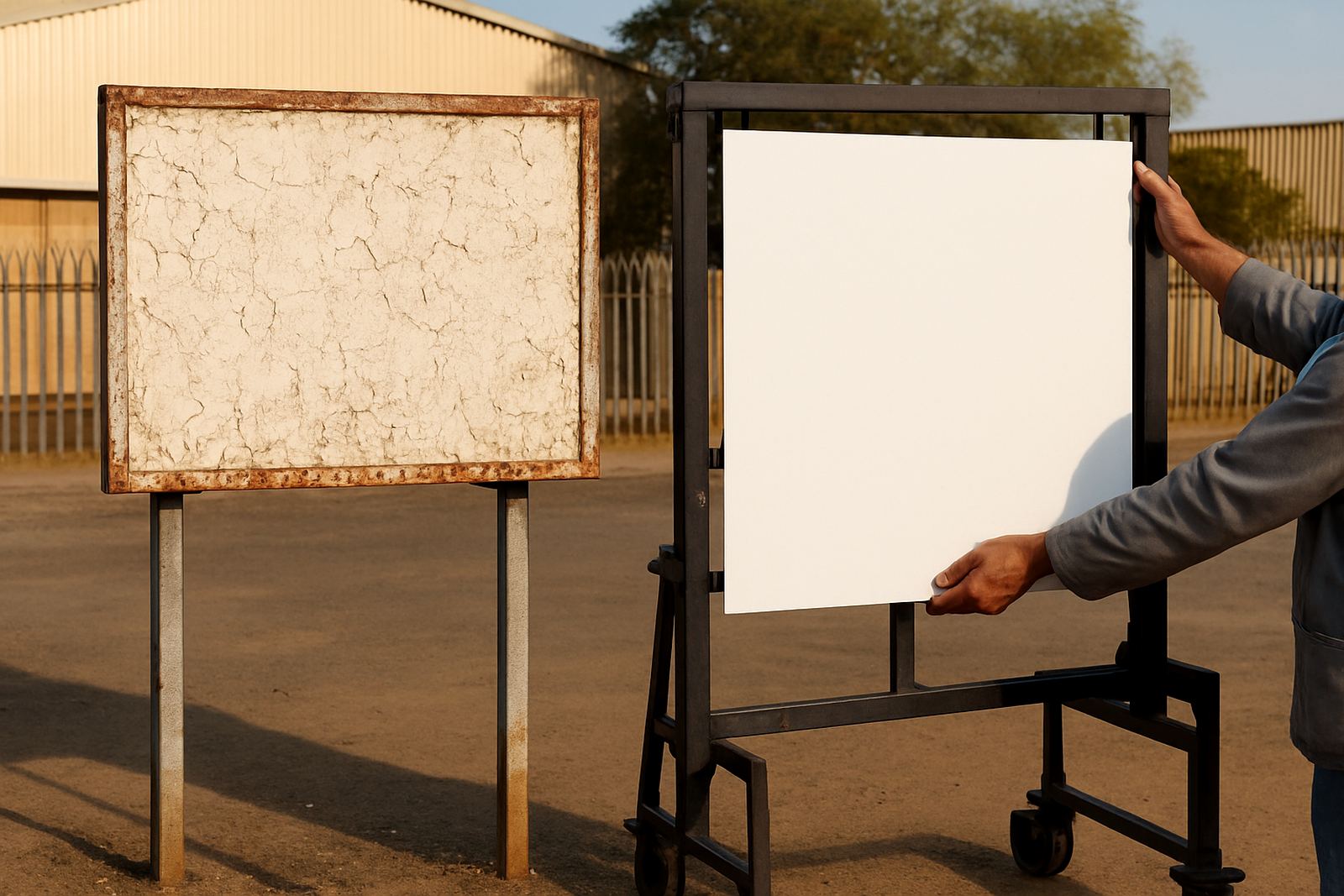
A sign is there to be read quickly, whether it is on a busy road in Boksburg, at a workshop gate in Germiston, or on a shopfront in Benoni. Once people need to squint, stop and guess, the sign has already lost value. At that point, replacement is usually better than trying to keep patching it up.
The most common triggers are simple: fading from strong Gauteng sun, peeling vinyl, cracked board material and contact details that no longer match the business. If the sign still looks presentable but no longer reflects who you are, that is also a good reason to replace it. A sign that says the wrong trading name or an old landline can send customers to the wrong place, or straight past you.
Clear signs of weather and age damage
In the East Rand, signs take a beating from UV, dust, rain and summer storms. In industrial areas you also get grime from traffic and factory activity, while coastal humidity is not the issue here, many clients still need durable finishes because of constant exposure and washing. Once the surface starts breaking down, the board often goes downhill fast.
- Vinyl letters lifting at the edges or bubbling after heat
- Ink that has gone chalky, dull or uneven in colour
- Rust streaks around fixings, frames or mounting points
- Cracks, warping or swelling on board material
- Water stains behind acrylic, perspex or printed panels
If you can see daylight through a sign panel, or if screws are pulling loose from the substrate, replacement is safer than waiting for a wind gust to finish the job. That matters on roadside boards and high mounted signs where a failure can become a hazard.
When the message is outdated, not just the paint
Some signs are structurally fine but commercially out of date. That still counts as a replacement job. If you have changed your services, updated your logo, moved premises, or switched to different contact numbers, the old sign is not helping anyone. It can even create admin problems when customers, suppliers or drivers end up at the wrong address.
This is common with estate-agent boards, site boards and fleet marking. A board printed for a short-term project may outlive the project itself, while a vehicle with old graphics can keep advertising a business unit that no longer exists. In Gauteng, where people move between Boksburg, Alberton, Edenvale and Midrand for work, accuracy matters more than ever.
- Outdated phone numbers, trade names or web details
- Expired permits, safety notices or site access instructions
- Old branding after a merger, rebrand or change in ownership
- Services shown on the sign that are no longer offered
When repair is enough and when replacement makes more sense
Not every damaged sign has to be replaced immediately. A small vinyl section may be repaired, a loose panel can be refastened and some faded boards can be revived with a fresh print layer. But once damage spreads, repair often becomes false economy. You end up paying for labour more than once, and the finish still looks tired.
A useful rule is to compare the cost of patching with the cost of a clean new sign. If the board is more than a few years old, has been repaired before, or needs several different fixes, replacement usually gives better value. It also lets you correct the layout, improve visibility and make sure the sign suits the site conditions properly. On busy roads or windy corners, that can make a big difference.
- Replace when the structure is failing or warped
- Replace when the artwork no longer reflects current branding
- Repair when the damage is localised and the base is still sound
- Replace when repeated maintenance visits are becoming too frequent
What to check before you decide
Before ordering a new sign, it helps to do a simple site check. Measure the viewing distance, note whether the sign faces direct sun, and look at how the board is mounted. A sign that works at 5 metres inside a yard may not work at 30 metres from a road entrance. Size, contrast and position all matter.
We often advise clients to think about the next 3 to 5 years, not only today. If the business is growing, a slightly larger board or a more durable finish may save money later. For sites with municipal rules, estate regulations or safety requirements, the replacement should also match the relevant wording and placement. This is especially important for construction sites, warehouses and access-controlled properties where compliance signs must stay legible.
- Is the sign easy to read from the main approach angle?
- Does the material suit sun, rain and regular cleaning?
- Will the lettering still be clear after load shedding and after dark?
- Are the contact details, hours and services still correct?
A Boksburg example: the sign that kept sending people away
A practical example is a factory entrance near the Boksburg industrial area where the gate sign had faded almost to grey. Drivers could still find the property if they knew it already, but new visitors kept slowing down, turning back, or asking security for directions. The business thought the issue was traffic, but the real problem was visibility. The sign had become part of the clutter, not the solution.
Once the board was replaced with stronger contrast, cleaner lettering and better mounting, the entrance was easier to spot from the road. The change was small, but it reduced confusion for deliveries and improved the site’s professional look. That is often the point people miss: a worn sign can cost more than it seems because it affects first impressions, safety and day to day operations all at once.
For businesses across Boksburg, Benoni, Germiston, Kempton Park, Alberton, Springs and Edenvale, the decision to replace a sign is usually not about looks alone. It is about making sure the business can be found, read and trusted quickly.
Plan the replacement before the old sign fails completely
If a sign is already peeling, cracked or carrying old information, it is best not to wait for a complaint or a storm to force the issue. Replacement can be scheduled around your trading hours, delivery windows and access needs, which usually makes the job simpler and less disruptive. It also gives time to sort artwork, measurements and fixing points properly.
For site boards, vehicle markings, safety signs and shopfront signs, a planned replacement is usually neater and more cost effective than an emergency one. It gives the production team room to check sizes, materials and installation methods so the final result fits the site. A good sign should hold up to weather, traffic and daily use without constant attention.
If you are unsure whether to repair or replace, a proper site survey is the safest place to start. It is the quickest way to see what can stay and what should go.